The audit and advisory firm Deloitte has been publishing its Real Index for a number of years now. Unlike asking prices, which are often considerably distorted, it captures the actual prices of completed sales. This gives investors a more complete picture of the price per square metre of residential property across Czechia. Once we pair this data with average wages in individual regions, we learn how many full annual salaries a prospective flat buyer in a given regional capital theoretically has to save up. In practice it is of course more, since even with the best will in the world nobody can save 100 % of their income.

Save for three years and you’ll have almost a whole flat in Ústí – or a quarter of one in Prague
The data shows that while the average resident of Ústí nad Labem needs only a little over four annual salaries for a standard sixty-square-metre two-room flat, in the second “cheapest” Moravian-Silesian Region it takes almost six. In the Karlovy Vary Region you will have to save just a few months longer. At the opposite end of the ranking lie, rather unsurprisingly, the South Moravian Region (11 annual salaries) and the City of Prague (almost 12 annual salaries).
On the edge of a “housing crisis”
Data on what percentage of their monthly wage the average resident of a given regional capital spends on rental housing tells a similar story. In Ústí nad Labem it is 27 %, in Ostrava 30 % and in Karlovy Vary 32 %. The other regional capitals hover just a few percentage points around the 35 % mark, again with two obvious exceptions: Prague (43 %) and Brno (as much as 44 % of a wage). The Economic Commission for Europe (UNECE) states in its guide that housing can be considered sustainably affordable only if households spend no more than including fees and energy) 30 % of their disposable income on all (!) housing costs (that is, . Countries where the figure is forty percent or more are labelled by this UN regional commission as places with “excessive housing costs”.
Big promises can be big mistakes
The estimated investment yield in the Ústí Region is 6.6 % p.a., and in four other regions it stays above the 5 % mark (Moravian-Silesian, Karlovy Vary, Zlín and Vysočina). By contrast, the Central Bohemian Region, the South Moravian Region and Prague are estimated to be around or just below 4 % annual yield. It is, however, important to stress that these figures do not include regional specifics such as the greater difficulty of finding solvent tenants, possible higher-than-usual wear and tear on the property, or outright large-scale damage, not to mention the far from trivial cost of evicting non-paying tenants. And there are far from negligible numbers of those in Czechia, as you could read last week on our blog in a separate article. Once these expected extra costs are factored in (and the acceptable level of risk is taken into account), an investment in Prague, Brno or one of the regional capitals in more stable regions away from the borderlands may be just as advantageous or even better.
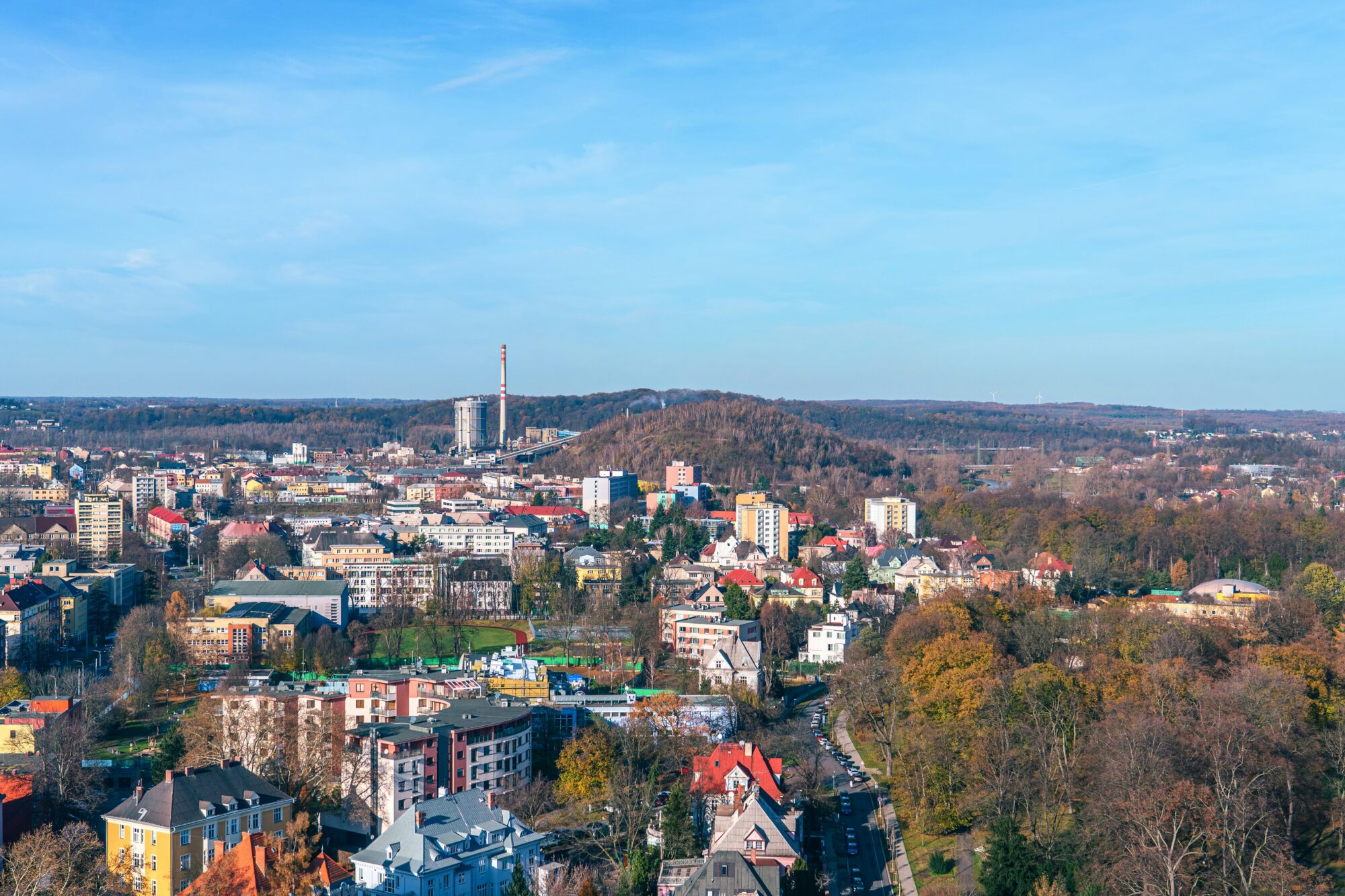
In smaller towns, a flat’s suitability as an investment can differ literally street by street
That is why it always pays to visit in person any property you are considering as an investment, rather than buying on the basis of pretty catalogue photos and estate agents’ promises. Go and get to know the location thoroughly, ask the locals and take an active interest in what is happening in the towns where you want to safely park your spare funds.
Market forces pulling in opposite directions
Investing in the regions is seen by many as a very attractive opportunity, yet the window of opportunity is slowly starting to close. Institutional investment funds are investing there ever more often, and pension funds will soon enter the market too. Property prices in the regions will be pushed by two different forces in the coming decades – in opposite directions. It will therefore be interesting to see which of them proves dominant. The gradual depopulation of the regions driven by the demographic situation and smaller birth cohorts could suggest that property prices will tend to fall. At the same time, a number of regional capitals should gradually be connected to the high-speed rail network some time between 2030 and 2040, opening up entirely new opportunities for owners and tenants to take up lucrative jobs in Prague or Brno. Remote work will also grow in popularity. That will push property prices up, because getting from a flat in Ústí nad Labem to the centre of Prague by high-speed train may well be a much shorter and more pleasant journey than from a satellite town just a few kilometres beyond the city limits. Are you considering buying an investment property, or do you already have one in your portfolio and plan to rent it out soon? Consider the services of an experienced property manager who will guide you through the administrative side of letting and help you find the ideal tenant who pays on time and without problems every month. You can find out more about our FLAT SERVICE Partner and Garant services on this website or from our colleagues at sales@flatservice.cz and on +420 277 000 330.